

Diversification is the closest thing investing has to a free lunch, and this post is about going back for seconds. The second helping? A whole world of investments beyond stocks and bonds, known as alternatives. For most of investing history, building a portfolio came down to one question: how much in stocks, and how much in bonds? Stocks played the growing part. Bonds played the steadying role. For decades, this simple equation worked well enough that very few people questioned whether it could be improved upon. And then came 2022.
We all remember 2022. Stocks tumbled 18.0%, and the steadying leg didn’t steady. The broad bond market fell 13.0%, while the 10-year Treasury dropped 17.8%, almost in lockstep with stocks. In nearly a century, stocks and the 10-year Treasury have both lost money in the same year only a handful of times, and 2022 was the only year both fell by double digits at once. We fixate on that year partly because it’s recent, but mostly because the stock-and-bond combination finally broke. The failure of bonds, the supposed safe harbor, stung the most. That experience sent investors looking elsewhere for ballast, and rightfully so. So where do they look? Increasingly, towards alternatives, a corner of the market once reserved for large institutions and the ultra-wealthy, yet more accessible today than at any point in history.
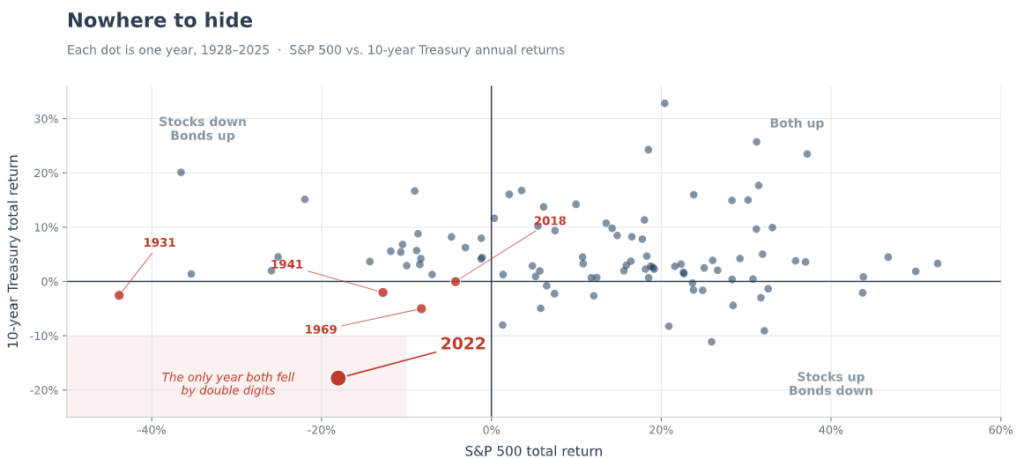
Source: NYU Stern (Aswath Damodaran), annual total returns 1928-2025
Alternative investments come in all shapes and sizes, to say the least. There’s no one-size-fits-all option that will magically solve your stability problem, especially as market correlations keep trending upward. There’s a common saying in this profession: “when traditional markets zig, you want alternatives to zag,” and day after day it keeps proving to be needed. But that’s easier said than done. The key is finding investments that show low-to-negative correlation not just to stocks and bonds, but to one another. And it pays to go a step further by stress-testing how each one holds up in times of real hardship. You might find two funds with attractive correlations on paper, but what’s the point if both sink together the moment markets are stressed? That defeats the whole purpose of the portfolio risk reduction you were looking for in the first place. Correlations are the foundation of diversification but taking it a step further is just as important. At a high level, alternatives break into two camps: what you can own and what you can run. The picture below shows a sample of these asset classes and strategies, a small slice of a much wider universe.
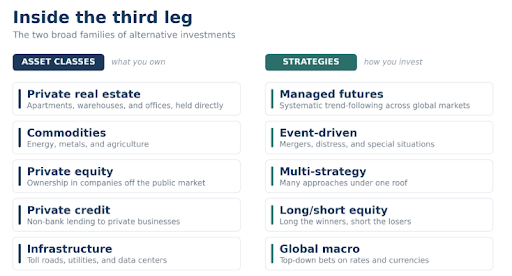
As you can probably guess, there are a good number of investment choices outside of stocks and bonds, but here is the catch, not all alternatives are doing the same job. It’s worth being careful not to assume a non-traditional asset class automatically offers strong diversification benefits. Just as comparing championship banners between Minnesota and Boston teams will only ever end one way, not all alternatives pull their weight equally as well. Some are built to diversify, like managed futures and global macro, which can rise when stocks and bonds are falling and smooth out the ride at the exact moment it matters most. Others are there to protect purchasing power, like real estate, commodities, and infrastructure, which tend to hold their value when inflation eats away at everything else. And a third group exists to enhance returns, like private equity and private credit, which aim to out-earn their public-market cousins in exchange for your patience and your willingness to lock up capital. But not every alternative has the same diversification impact, and the correlations below show just how differently these groups behave against stocks, bonds, and each other dating back to the beginning of 2018.
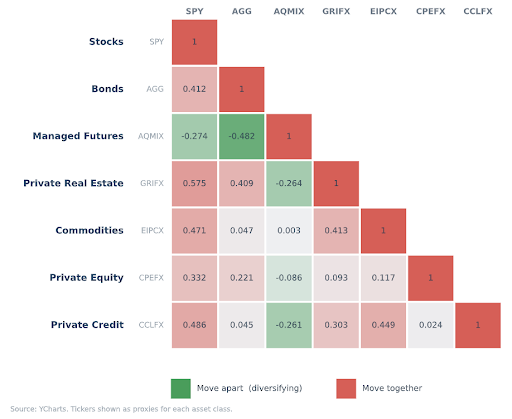
Source: YCharts. Tickers shown as proxies for each asset class
At Trademark Financial Management, we understand that all types of alternative investments can play a role in a portfolio depending on your objectives, time horizon, and risk tolerance. The combination of different types can create a portfolio that doesn’t lean on any single outcome going right. Used well, they become a valuable tool for long-term success and capital protection. To harness the power of long-term compounding, it helps to reduce portfolio risk and limit the unnecessary idiosyncratic risk you’re carrying. And remember this. A 50% drawdown doesn’t need a 50% gain to get back to even. It needs 100%. Let that sink in. It’s the same principle behind everything we build: structure first, with every piece there for a specific reason. Building wealth isn’t only about how much you make. It’s about how little you give back when things go wrong, and that is where alternatives earn their keep.
References:
Damodaran, Aswath. “Historical Returns on Stocks, Bonds and Bills: 1928–2025.” NYU Stern School of Business, January 2026. https://pages.stern.nyu.edu/~adamodar/New_Home_Page/datafile/histretSP.html
Source: YCharts. Monthly return correlations, January 2018–present. Tickers shown are proxies for each asset class: SPY (stocks), AGG (bonds), AQMIX (managed futures), GRIFX (private real estate), EIPCX (commodities), CPEFX (private equity), CCLFX (private credit).
DISCLOSURE
Past performance is no assurance of future results. Trademark Financial Management, LLC (“Trademark”) is a registered investment adviser with its principal place of business in the State of Minnesota. Trademark and its representatives are in compliance with registration requirements imposed upon investment advisers by those states in which Trademark operates. Trademark may only transact business in those states in which it is registered or qualifies for an exemption or exclusion from registration. This newsletter is limited to the dissemination of general information pertaining to its investment advisory/management services. Any subsequent, direct communication by Trademark with a prospective client shall be conducted by a representative that is either registered or qualifies for an exemption or exclusion from registration in the state where the prospective client resides. A complete list of all recommendations will be provided if requested for the preceding period of not less than one year. It should not be assumed that recommendations made in the future will be profitable or will equal the performance of the securities in this list. Opinions expressed are those of Trademark Financial Management and are subject to change, not guaranteed and should not be considered recommendations to buy or sell any security. For information pertaining to the registration status of Trademark please contact Trademark at (952) 358-3395 or refer to the Investment Adviser Public Disclosure web site (www.adviserinfo.sec.gov). For additional information about Trademark, including fees and services, send for our disclosure statement as set forth on Form ADV from us using the contact information herein or by calling 952-358-3395. Please read the disclosure statement carefully before you invest or send money. Any reference to a chart, graph, formula, or software as a source of analysis used by Trademark Financial Management staff is one of many factors used to make investment decisions for your portfolio. No one graph, chart, formula, or software can in and of itself be used to determine which securities to buy or sell, when to buy or sell them, or assist any person in making decisions as to which securities to buy or sell or when to buy or sell them. Any chart, graph, formula, or software used is limited by the data entered and the created parameters. The data was obtained from third parties deemed by the adviser to be reliable. Nonetheless, the adviser has not verified the results and cannot be assured of their accuracy.