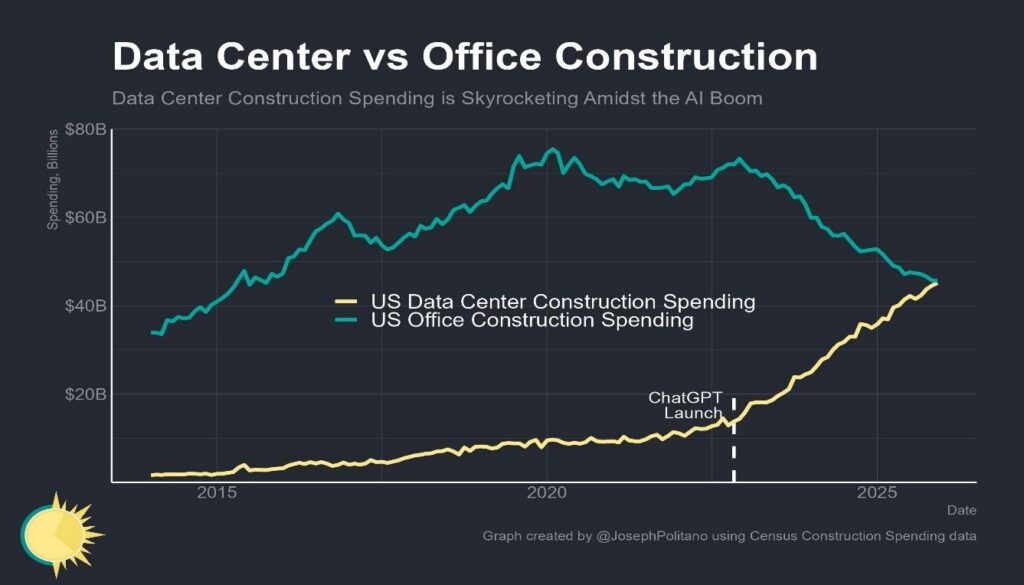
This may be the biggest AI month in terms of impact that we’ve had so far. Markets had priced in winners before, but in February 2026 they finally got around to thinking about who would be the losers. And they decided that the companies that provide software as a service, the financial companies that lent money to those SaaS firms, and the employees who work at those firms would be the losers. Once you start thinking about losers, it’s a short jump to thinking about the potential contractionary effects of AI, and you start to warm up to the idea that interest rates might fall. Ten-year bond yields plunged to a four-month low of 3.96% while mortgage rates finally went under 6%. All that on a day where producer price inflation spiked upward. Economic fear is starting to trump inflation concern. That means stocks and bonds will move in the opposite direction.
Investors should also be aware that quality is winning in the bond market right now. Yield spreads are modestly widening as investors get nervous about the lowest quality credits. Private credit, which is basically low quality (BB-CC) credit, has had a couple of nasty days this week in the wake of the default of a British mortgage originator and the run on Blue Owl assets. Financial company stocks got pummeled this week. We are all in the position now of hoping that the current difficulties are isolated and not symptomatic of a much larger credit problem (a la 2008).
We now have to look at the stock market with more nuance. The trade from November through January was to sell technology/large cap growth and buy value/small cap/international. As we discovered this past week, however – financials (banks, insurance companies, global asset managers) are generally found in value funds, and they were easily the worst performers. As for small caps, they had a nice rally early in the year as money came out of the Mag 7 and tax loss selling dried up, but they peaked on January 22. They are now down more than 3% from those highs. Only international stocks are continuing to reward the money that has come out of large U.S. tech stocks.
Beyond that, the precious metals trade continues to work. Unless you bought gold at the top of the spike (January 28th and 29th) you have a profit. Mining stocks have actually surpassed their end-of-January highs because profits margins are so high with gold near $5200/oz. Silver had a much bigger spike and a much more severe fall, so while it was up in February it is well below its January high. Copper and oil continue their sharp 2026 ascent as each are important components to the AI build out.
So the bottom line is be careful. The bond market thinks that the average consumer is weak, aggregate metrics notwithstanding, and that interest rates are going to surprise to the downside. The stock market thinks that interest rates are going lower even though inflation is still in the 3% range because of weakening labor, and it is expressing its fear of “debasement” in terms of buying gold and silver. Other industrial metals are gaining on the “we need more power” trade.
DISCLOSURE
Past performance is no assurance of future results. Trademark Financial Management, LLC (“Trademark”) is a registered investment adviser with its principal place of business in the State of Minnesota. Trademark and its representatives are in compliance with registration requirements imposed upon investment advisers by those states in which Trademark operates. Trademark may only transact business in those states in which it is registered or qualifies for an exemption or exclusion from registration. This newsletter is limited to the dissemination of general information pertaining to its investment advisory/management services. Any subsequent, direct communication by Trademark with a prospective client shall be conducted by a representative that is either registered or qualifies for an exemption or exclusion from registration in the state where the prospective client resides. A complete list of all recommendations will be provided if requested for the preceding period of not less than one year. It should not be assumed that recommendations made in the future will be profitable or will equal the performance of the securities in this list. Opinions expressed are those of Trademark Financial Management and are subject to change, not guaranteed and should not be considered recommendations to buy or sell any security. For information pertaining to the registration status of Trademark please contact Trademark at (952) 358-3395 or refer to the Investment Adviser Public Disclosure web site (www.adviserinfo.sec.gov).
For additional information about Trademark, including fees and services, send for our disclosure statement as set forth on Form ADV from us using the contact information herein or by calling 952-358-3395. Please read the disclosure statement carefully before you invest or send money. Any reference to a chart, graph, formula, or software as a source of analysis used by Trademark Financial Management staff is one of many factors used to make investment decisions for your portfolio. No one graph, chart, formula, or software can in and of itself be used to determine which securities to buy or sell, when to buy or sell them, or assist any person in making decisions as to which securities to buy or sell or when to buy or sell them. Any chart, graph, formula, or software used is limited by the data entered and the created parameters. The data was obtained from third parties deemed by the adviser to be reliable. Nonetheless, the adviser has not verified the results and cannot be assured of their accuracy.
End of November Market Update
1. The top story in November was the surge in both gold and silver. Gold is up 60.3% year-to-date and 9% so far this quarter, while silver’s gains are 94.6% and 22%. There are many theories as to why precious metals have performed so well this year. Dollar weakness might have explained the first half surge, but the dollar has been up since June. Significant concerns about U.S. monetary policy once Federal Reserve Chairman Jerome Powell is gone is probably the biggest contributor to the precious metals surge this quarter.
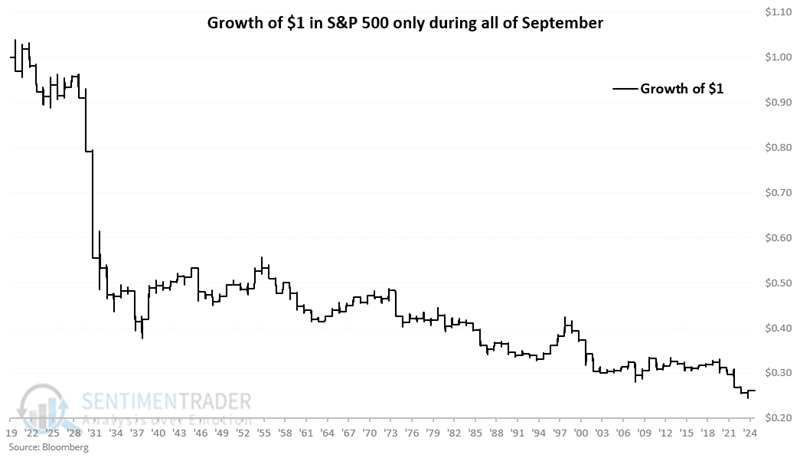
2. The S&P 500 recovered in the last week of the quarter to post a very modest 0.1% monthly gain. This was its seventh consecutive monthly gain. Almost certainly the streak would have ended without the thin trading conditions the day before and after Thanksgiving. We will probably give that back on December 1st (at least, that has been the pattern). I bring this up because I feel that the U.S. stock market is tired. Typically, there is a correction in September that provides the fuel for an end-of-year rally. We didn’t get that this year. The only catalyst the market seems to have right now is the growing prospect of a Fed easing on December 10th.
3. High yield bonds, which can be a canary in the coal mine in terms of giving advance warning of an economic downturn, have been underperforming so far this quarter. I’m keeping an eye on this in the wake of the well-publicized collapse of two entities heavily funded by private credit. I want to see if there are more “cockroaches” to be discovered. The market has become cautious, but not fearful in this area.
4. Healthcare was by far the biggest sector winner in November. It is thought that investors are catching on to the myriad benefits of AI to the health care sector in terms of drug discovery and targeted treatment. That said, technical indicators suggest it may be overbought in the short term (RS reached 76 on Tuesday). By and large this is not an expensive sector (Eli Lilly notwithstanding), so I believe it can be an outperformer into 2026.
5. Bitcoin has been struggling mightily this quarter. Having topped $127,000 on October 6th, it is below $90,000 today. I look at bitcoin as a proxy on speculation/excess liquidity in the market, and clearly that kind of activity has been in sharp decline lately. For this reason, I am not overly optimistic on the technology sector in the near terms – tech and bitcoin tend to have a high positive correlation.
6. The Russell 2000 is up 2.6% this quarter. That compares favorably to a 2.4% gain for the S&P 500. It does not signal, however, a breakout in small cap stocks. Small cap bulls can claim a 2% performance advantage since November 14, but expanding the chart out to look at a 12 or 24 month perspective does no favors for small caps – lower relative highs and lower lows. I’d LOVE for this to change. We would certainly benefit from diversification bearing more fruit, but the charts don’t show anything more than a periodic uptick so far.
7. For the most part, foreign stocks have tracked the 2.5% gain in U.S. stocks quarter-to-date. Latin America has been the best performing region. Performance has generally favored large value-oriented funds overseas. The Asia tech trade, which was strong all summer, was especially weak in November.
DISCLOSURE
Past performance is no assurance of future results. Trademark Financial Management, LLC (“Trademark”) is a registered investment adviser with its principal place of business in the State of Minnesota. Trademark and its representatives are in compliance with registration requirements imposed upon investment advisers by those states in which Trademark operates. Trademark may only transact business in those states in which it is registered or qualifies for an exemption or exclusion from registration. This newsletter is limited to the dissemination of general information pertaining to its investment advisory/management services. Any subsequent, direct communication by Trademark with a prospective client shall be conducted by a representative that is either registered or qualifies for an exemption or exclusion from registration in the state where the prospective client resides. A complete list of all recommendations will be provided if requested for the preceding period of not less than one year. It should not be assumed that recommendations made in the future will be profitable or will equal the performance of the securities in this list. Opinions expressed are those of Trademark Financial Management and are subject to change, not guaranteed and should not be considered recommendations to buy or sell any security. For information pertaining to the registration status of Trademark please contact Trademark at (952) 358-3395 or refer to the Investment Adviser Public Disclosure web site (www.adviserinfo.sec.gov).
For additional information about Trademark, including fees and services, send for our disclosure statement as set forth on Form ADV from us using the contact information herein or by calling 952-358-3395. Please read the disclosure statement carefully before you invest or send money. Any reference to a chart, graph, formula, or software as a source of analysis used by Trademark Financial Management staff is one of many factors used to make investment decisions for your portfolio. No one graph, chart, formula, or software can in and of itself be used to determine which securities to buy or sell, when to buy or sell them, or assist any person in making decisions as to which securities to buy or sell or when to buy or sell them. Any chart, graph, formula, or software used is limited by the data entered and the created parameters. The data was obtained from third parties deemed by the adviser to be reliable. Nonetheless, the adviser has not verified the results and cannot be assured of their accuracy.
End of October Market Update
· This was a huge month for biotechnology. Biotech is a very long duration asset (many companies are far from their first profits), so they benefit greatly from lower interest rates.
· This was also a very good month for solar/clean energy. Strangely, this industry tends to move counter-intuitively (meaning not at all like political control would make you think).
· October was also a huge month for semi-conductors, as demand continues to be essentially infinite.
· Infrastructure funds had a good month, as industrial, utility, and materials stocks tied to the AI build-out over-performed.
· The performance advantage of large caps over small caps was big once again, but mid-caps were actually the worst performers.
· Gold set an all-time high mid-month, but dollar strength and profit taking has fueled a 9% plus sell-off since then. For gold mining stocks, the decline is 16%. The gold rally was largely predicated on irresponsible central bank behavior. If Fed Chairman Powell stands up to Trump and doesn’t cut rates in December, alternative currencies (gold and bitcoin) are probably not going to do well.
· The market sectors to have avoided in October: Retail/Discretionary, Energy, Real Estate, and Financials. Worst of the worst: Pipelines, homebuilders, Small Banks, and Insurance.
· Emerging Markets performed very well, led by Argentina (35%, on U.S. financial support) and South Korea (21%, on the agreement to provide Nvidia chips to their technology companies). India finally had a good month.
· Dividend-focused strategies are lagging the market on both a monthly and a yearly basis.
· AI is really hurting business models that depend on selling information. Consulting and business services (Moody’s, Fair Isaac, etc.) have commanded premium multiples for years if not decades, but those multiples are shrinking fast.
· Bonds rallied hard from May 21 (“maybe these tariffs aren’t going to be as inflationary as we thought”) to October 28 (we aren’t seeing much of an economic slowdown despite the shutdown. What if Powell hints that he might not cut in December?”). Bonds have lost about 1% since then, but I’m still inclined to be bullish.
Conclusions:
· I believe gold is a weak holding until the market begins to focus on Powell’s successor, which might not be until March or so (his term ends in May).
· Seasonally the stock market is moving into a stronger period (November-January). Investors tend to buy strength to pad their returns. I see large cap growth continuing to lead, partially because the arguments for defensive industries and smaller companies are just not economically supported.
· Japan, under it’s new Prime Minister, is returning to it’s super easy monetary policy stance. Because of this, the yen is falling and Japanese stocks are rising. More importantly for global investors, the “carry trade” is working again (borrow in Yen, buy global risk assets). As ridiculous as one might find the valuation of a stock like Palantir (300 times next year’s earnings, 142 times sales), this is why you can’t short it now.
DISCLOSURE
Past performance is no assurance of future results. Trademark Financial Management, LLC (“Trademark”) is a registered investment adviser with its principal place of business in the State of Minnesota. Trademark and its representatives are in compliance with registration requirements imposed upon investment advisers by those states in which Trademark operates. Trademark may only transact business in those states in which it is registered or qualifies for an exemption or exclusion from registration. This newsletter is limited to the dissemination of general information pertaining to its investment advisory/management services. Any subsequent, direct communication by Trademark with a prospective client shall be conducted by a representative that is either registered or qualifies for an exemption or exclusion from registration in the state where the prospective client resides. A complete list of all recommendations will be provided if requested for the preceding period of not less than one year. It should not be assumed that recommendations made in the future will be profitable or will equal the performance of the securities in this list. Opinions expressed are those of Trademark Financial Management and are subject to change, not guaranteed and should not be considered recommendations to buy or sell any security. For information pertaining to the registration status of Trademark please contact Trademark at (952) 358-3395 or refer to the Investment Adviser Public Disclosure web site (www.adviserinfo.sec.gov).
For additional information about Trademark, including fees and services, send for our disclosure statement as set forth on Form ADV from us using the contact information herein or by calling 952-358-3395. Please read the disclosure statement carefully before you invest or send money. Any reference to a chart, graph, formula, or software as a source of analysis used by Trademark Financial Management staff is one of many factors used to make investment decisions for your portfolio. No one graph, chart, formula, or software can in and of itself be used to determine which securities to buy or sell, when to buy or sell them, or assist any person in making decisions as to which securities to buy or sell or when to buy or sell them. Any chart, graph, formula, or software used is limited by the data entered and the created parameters. The data was obtained from third parties deemed by the adviser to be reliable. Nonetheless, the adviser has not verified the results and cannot be assured of their accuracy.
Market Thoughts – August 29, 2025
1. Growth stocks seem a little tired. Give them credit where it is due, they have sizzled over the last few months. However, in the wake of Nvidia’s extremely-solid-but-not-quite-lights-out earnings report and strong-but-not-pound-the-table-strong forward guidance, investors have decided that the tech sector might need to rest for a little while. Secondary tech names are getting crushed when they disappoint, and even some leaders (Microsoft, Meta) are giving back all of their post-earnings gains. Apple was the best performing Mag 7 stock in August because it has tens of billions in cash on hand.
2. Defensive stocks started to catch a bid in August. Speaking of large cash hoards, Berkshire Hathaway had been selling off for three straight months after Chairman Warren Buffett announced that he was stepping down back on May 3rd. It hit a low of $459 on August 4th, off 15% from its May 2 high. It’s up $45 (10%) since then. High free cash flow as a factor, which lagged badly from January through July, was the second-best factor in August (after small size). Even beat-up health care stocks began to catch a bid this month.
3. Every knock against the Federal Reserve as an institution or at individual members of the Fed only serve to make investors nervous about America’s commitment to sound monetary policy. And as result, they buy more gold. Gold bullion gained 4% in August. Gold mining stocks soared 19%, because the price of gold is now so much higher than the cost of mining it. If you are curious, bitcoin fell 7% in August. Whatever it is, bitcoin is not a hedge against financial instability.
4. The dollar declined in August after a very strong July. Not surprisingly, foreign stocks outperformed U.S. stocks in dollar terms. Vietnam was the best performing foreign market (and I think we all can guess why). China was the best larger market, which is obviously related to the strength in Vietnam. India was the worst foreign market, probably due to the tariffs imposed on them by the Trump Administration to punish them for buying Russian oil. Brazil is also being punished by Trump (in this case for matters completely unrelated to national security), but it still managed to gain 10% last month.
5. I would like to tell you that all the strategists were right and lengthening maturities in August paid off. And to a degree I can – intermediate term bonds added about 1.2% versus 0.4% for ultra-short (less than 9 months) bonds and 0.7% for short term (9 months to 3 years) bonds. If you bought long bonds, however, your return diminished. The benchmark gained 0.9% while the 30-year lost 1.5%. Investors are worried about long term inflation. That’s why the best domestic bond category last month was inflation protected securities (+1.5%). Overall, the best category was local currency emerging market debt (+2.1%).
6. September is seasonally not a very good month for U.S. stock investors. With technical indicators already showing signs of upside exhaustion, be careful here. You’ll probably get a better buying opportunity in October. Even the hope of a Fed rate cut on September 17 is probably already discounted in stock prices, so it likely wouldn’t move the market unless Powell suggested that more cuts were coming.
DISCLOSURE
Past performance is no assurance of future results. Trademark Financial Management, LLC (“Trademark”) is a registered investment adviser with its principal place of business in the State of Minnesota. Trademark and its representatives are in compliance with registration requirements imposed upon investment advisers by those states in which Trademark operates. Trademark may only transact business in those states in which it is registered or qualifies for an exemption or exclusion from registration. This newsletter is limited to the dissemination of general information pertaining to its investment advisory/management services. Any subsequent, direct communication by Trademark with a prospective client shall be conducted by a representative that is either registered or qualifies for an exemption or exclusion from registration in the state where the prospective client resides. A complete list of all recommendations will be provided if requested for the preceding period of not less than one year. It should not be assumed that recommendations made in the future will be profitable or will equal the performance of the securities in this list. Opinions expressed are those of Trademark Financial Management and are subject to change, not guaranteed and should not be considered recommendations to buy or sell any security. For information pertaining to the registration status of Trademark please contact Trademark at (952) 358-3395 or refer to the Investment Adviser Public Disclosure web site (www.adviserinfo.sec.gov).
For additional information about Trademark, including fees and services, send for our disclosure statement as set forth on Form ADV from us using the contact information herein or by calling 952-358-3395. Please read the disclosure statement carefully before you invest or send money. Any reference to a chart, graph, formula, or software as a source of analysis used by Trademark Financial Management staff is one of many factors used to make investment decisions for your portfolio. No one graph, chart, formula, or software can in and of itself be used to determine which securities to buy or sell, when to buy or sell them, or assist any person in making decisions as to which securities to buy or sell or when to buy or sell them. Any chart, graph, formula, or software used is limited by the data entered and the created parameters. The data was obtained from third parties deemed by the adviser to be reliable. Nonetheless, the adviser has not verified the results and cannot be assured of their accuracy.
Market Thoughts
Another strong month for the S&P 500 is in the books. The S&P 500 tacked on another 2.2% to get the YTD figure up to 8.4%. The NASDAQ was even stronger at 2.4% and 10.6%, on the back of continued strength from all but two of the Mag 7. Still, when you look at the rest of the U.S. market the month was not all that impressive. Value stock indices rose only half of one percent. Small and midcap stocks rose 1.5% but were very weak over the last five trading days. It just seems like the market has done almost all it can with the good news it has received over the past three months.
International stocks lost money in July. The dollar had a pretty strong month as it rebounded from the oversold levels it hit in early July. Both Japan and Europe made trade deals with the US that appear to be very one-sided, which has positively changed the near- term sentiment towards the dollar. It will be interesting to see if those agreements are actually what they appear to be (or merely just “frameworks” for a deal). It would be fairly shocking if the people of the EU countries accepted the terms as they now stand.
India had a very rough month. President Trump put a 25% tariff on India to punish it for doing business with Russia. Next to Brazil, who Trump punished even more because he is friends with Bolsonero, India was the worst performing significant market. You have to think that every country is thinking about how to reduce its vulnerability to U.S. trade policy.
This morning’s Unemployment Report was a shocker! The 73,000 July figure was disappointing as 110,000 was expected, but it was hardly a market mover in and of itself. The big negative market reaction was for the revisions to the previous two months. May was revised down from 144,000 to 19,000, and June from 147,000 down to 14,000. Those were MASSIVE revisions! The whole narrative flips now from “tariffs don’t seem to be costing the economy anything, so we don’t have to worry about the new ones going into effect in August” to “everything we thought was wrong. Tariffs have been costing the economy jobs for the last three months and now they are about to get even worse”. This is to say nothing about the nature of revisions so large – was it poor data collection in the wake of DOGE cuts or is data being manipulated to appear good upon first release and then the true number is quietly revealed later? In either event, global equity markets are going to struggle with this news, while high quality fixed income should benefit from rates that are almost certainly going lower.
The dollar, which rose almost 4% in July, has given back 1.2% so far this morning. This is enabling foreign equities to lose less than the U.S. for the first time since late May. I suspect there will be those that see this morning’s action as a dip to be bought, but I would agree only if I knew that the proposed tariff increases this month were to again be postponed or rescinded. Either way, I believe bonds are going to see inflows and gold should also benefit as a September rate cut seems all but assured. Some of the hotter areas of the stock market, like semiconductors and the fintech/crypto space, will probably need to consolidate a bit.
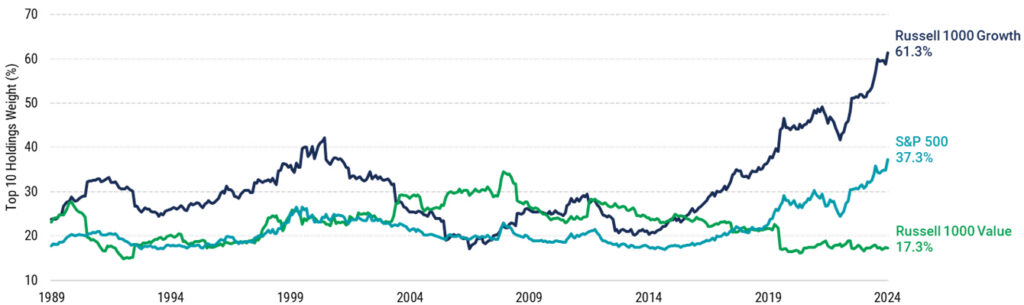
One other thing. The most recent Russell ETF reclassification puts Amazon, Alphabet, and META into the Russell 1000 Value Index. If you thought these were growth stocks you can rest easy, they are all still in the Russell 1000 Growth Index as well. If it was your hope that you could use the Russell indices to help you diversify your portfolio and thereby reduce risk, however, I have bad news. If there is a significant technology downturn like there was in 2000 and investors rotate to other industries, your passive value fund is not going to save you.
This might be the thing that revives the municipal bond market. Munis have been plagued for years by low coupons and long durations. This year their prices fell into the dirt-cheap category as municipal issuers sought to float their bonds before the tariffs and the budget bill went into effect, so supply became yet another headwind. Now we may finally be seeing the kind of slowdown that makes these generally high-quality fixed income securities the toast of the bond market again. Tax equivalent yields on investment grade munis are near 7%, whereas on corporate bonds they are less than 6%.
DISCLOSURE
Past performance is no assurance of future results. Trademark Financial Management, LLC (“Trademark”) is a registered investment adviser with its principal place of business in the State of Minnesota. Trademark and its representatives are in compliance with registration requirements imposed upon investment advisers by those states in which Trademark operates. Trademark may only transact business in those states in which it is registered or qualifies for an exemption or exclusion from registration. This newsletter is limited to the dissemination of general information pertaining to its investment advisory/management services. Any subsequent, direct communication by Trademark with a prospective client shall be conducted by a representative that is either registered or qualifies for an exemption or exclusion from registration in the state where the prospective client resides. A complete list of all recommendations will be provided if requested for the preceding period of not less than one year. It should not be assumed that recommendations made in the future will be profitable or will equal the performance of the securities in this list. Opinions expressed are those of Trademark Financial Management and are subject to change, not guaranteed and should not be considered recommendations to buy or sell any security. For information pertaining to the registration status of Trademark please contact Trademark at (952) 358-3395 or refer to the Investment Adviser Public Disclosure web site (www.adviserinfo.sec.gov).
For additional information about Trademark, including fees and services, send for our disclosure statement as set forth on Form ADV from us using the contact information herein or by calling 952-358-3395. Please read the disclosure statement carefully before you invest or send money. Any reference to a chart, graph, formula, or software as a source of analysis used by Trademark Financial Management staff is one of many factors used to make investment decisions for your portfolio. No one graph, chart, formula, or software can in and of itself be used to determine which securities to buy or sell, when to buy or sell them, or assist any person in making decisions as to which securities to buy or sell or when to buy or sell them. Any chart, graph, formula, or software used is limited by the data entered and the created parameters. The data was obtained from third parties deemed by the adviser to be reliable. Nonetheless, the adviser has not verified the results and cannot be assured of their accuracy.
Quarterly Market Summary
Summary
What a turnaround! Stocks soared to a 10.9% quarterly return last quarter after President Trump reversed himself on tariffs. The “Liberation Day” tariff announcement on April 2nd caused a further 12% one-week sell-off after stocks had already fallen 8% from their February 19th highs. Investor sentiment was grim. Then, on April 9th, tariffs on foreign-made goods were largely rescinded for the time being. Stocks rose over 8% that day. Gradually, investors began to believe that their fears about inflation and recession might be overblown. They reasoned that if the administration was simply employing an aggressive negotiating tactic and never really planned on going through with tariffs of 50% and higher, maybe they aren’t as reckless as first thought. The rally really got going after Microsoft’s surprising large earnings beat on April 30th and semiconductor giant Nvidia’s assurance in May that the AI race was just getting started.
As a result, technology was the big sector winner last quarter with a 22.9% gain, but industrials also gained over 12%. Defensive industries like consumer staples (no growth), health care (RFK Jr., Medicaid cuts), and energy[1] lagged badly. U.S stocks are up 6.2% through June 30th.
Foreign stocks have done much better. In local currencies, world stocks rose 8.3% in the first half of the year. Because the U.S. dollar fell sharply as global investors shifted assets out of U.S. markets, dollar-based investors earned nearly 11% more by investing overseas. This finally provided some validation for proponents of international diversification after years of under-performance due to a strong dollar and a less advantageous industry mix[2]. Asian stocks gained the most last quarter led by China. Lessening of trade frictions were good for everybody, but the U.S. and China benefitted the most.
Bonds gained 1.2% last quarter. This is big “cool down” after a strong (2.8%) first quarter. Yields have steadied in a narrow range as investors weigh where inflation and tariff policy are going next. Non-US debt continued to benefit from a weaker dollar. Private credit and mortgage bonds also outperformed. Municipal bonds were once again the worst bond sector. They have become very cheap now, and many bond market experts are saying that this is the time to buy.
Alternative assets such as gold and bitcoin have been choppy, but both have had multiple surges to new highs this year.
Activity
The second quarter came in like a shark and went out like a kitten. The first six trading days of the quarter were wracked with tariff fears and selling, then we got the policy reversal, and then investors increasingly traded stable assets for those that had more upside potential. The key consideration for performance was how strongly one altered their positioning in March in anticipation of tariffs and how quickly one reversed those changes in April or May once the tariff scenario changed. We made moderate risk-off moves in March. By early May we had repositioned portfolios back toward risk assets, but not quite as much as if the whole thing hadn’t happened in the first place. Policy volatility continues to make this an exceptionally challenging (but not necessarily bad!) time to invest.
Outlook
Investors have learned, over the past fifteen years, that if you get a meaningful dip in stock prices you better be a buyer. The vehemence with which bearishness switched to bullishness has reinforced the notion that selling is dangerous – you are probably going to have to buy back whatever you sell, and the price may well be higher then. There are some large tariffs set to take place early next month which if implemented would likely cause stocks here and overseas to fall, but as I write this on July 17, 2025 – the stock market isn’t putting much stock into those concerns. Nobody wants to be the guy who sold out and now has egg on his face because the tariffs were just a bluff and never went into force. In essence the market is playing a giant game of chicken, so to speak. I hope it doesn’t have to blink this time.
Commentary – Warren Buffett and Michael Saylor
This seems like an appropriate time to appreciate the career of Warren Buffett, the chairman of Berkshire Hathaway and perhaps the most famous and successful investor of the past 75 years. Mr. Buffett announced in May at the annual shareholders’ meeting that he was turning the chief executive officer role over to a successor. The 94-year-old Buffett is probably most well-known for his stellar long-term returns, but to professionals his standout quality was his patience. His best returns often came from stocks that had their best years long after Berkshire first purchased them. Mr. Buffett exploited a huge behavioral weakness that investors have – the inability to accurately assess opportunities and risks that would take years instead or months to play out. Time after time he would buy stakes in strong companies that were facing a near-term challenge, then hold them while the challenge was overcome and the stock returned to its upward trajectory. A less appreciated but also important behavioral skill he possessed was the ability to avoid being drawn in by short-term market fads. He would rather let cash accumulate on Berkshire’s balance sheet than overpay for a company just because it was doing well. If you are patient, he argued, you do not have to pay top dollars for the best companies. Eventually, they will come to you. For example, he earned tens of billions of dollars for Berkshire by buying Apple stock during slumps in 2013 and 2016[1].
Warren Buffett’s approach is known as value investing, and it was the model for investing in the 20th Century. It was taught and is still taught in business schools and in the CFA program. But value investing is not the way that most investing is done today. Michael Saylor is the Executive Chairman of a company called MicroStrategy (now just Strategy), and he is a pretty good example the modern investment approach. Strategy borrows money in the bond market and uses the proceeds from its borrowing to buy bitcoins. This works because investors currently value Strategy at roughly twice the value of the bitcoins it holds. Why? Because there are many things you can do with bitcoins (including lending it to speculators for a tidy fee) and because the Trump Administration is very crypto-friendly and is likely to approve even more uses for bitcoin. Since bitcoin was invented back in 2008 it has both risen tenfold and lost two-thirds of its value several times. If Buffett’s edge is patience, Saylor’s edge is fortitude. He can psychologically withstand brutal downturns that the vast majority of investors cannot.
I bring up this comparison not because either Buffett or Saylor is a good or smart person or has the better approach but because I believe both are a product of their times. Warren Buffett was born during the Great Depression. He saw both a World War and decade long periods of time where stocks made investors less than nothing after inflation. He was influenced by Benjamin Graham’s idea of “Margin of Safety” which is decidedly a “First Principle – Don’t lose money” kind of philosophy. On the other hand, Michael Saylor started MicroStrategy in 1989. His investment career coincided with relative political stability and huge gains in the market punctuated by brief downturns in 2000-02, 2007-09, and even shorter ones in 2020 and 2022. He is a very successful investor during a climate where no matter how far asset prices fell, they always came roaring back in fairly short order. Those who picked the right asset (Apple, Nvidia, bitcoin) and went “pedal to the metal” made the most money – if they didn’t lose their nerve. Such is growth investing, and its superiority this century has been amazing.
Maybe this is how the rest of the decade will go. Maybe this is how the entire twenty-first century will go. All I can say is that I can’t believe that it will, and I cannot professionally or personally invest as if I think it will. As a student of market history (going back two centuries), I have recognized a pattern of increasingly speculative excess leading ultimately to very deep busts. The success of Strategy by itself doesn’t say anything about whether or not this is the pre-bust part of a great market cycle. Saylor may just be one of those investment geniuses that arise during both good periods and bad. But coupled with the rise in ways to outright gamble on the market, especially the explosion in options and other forms of leverage and online trading forums, I am convinced that this is one of those speculative eras that will not end well.
That said, I also know that it is beyond my ability to predict when this will happen, so getting super defensive and waiting is just not an option. I know people who have tried that.
Investing always involves risk, but today it involves more risk than usual. Not just because prices are high historically[i], but because there is a similar embrace of risk-taking and risk-takers that I’ve read about in the late 1800s and the 1920s and I lived through in the late 1990s. Moreover, this higher risk behavior is taking place at the same time as America’s policy framework is undergoing significant changes not seen since the 1930s, and at a time where corporate America is betting VERY BIG on artificial intelligence. Those are important topics whose implications I’d like to address in future Commentaries, but don’t have enough room left in this one.
So, in conclusion I’d like to thank Warren Buffett for his contributions to the field of investment analysis and management as well as to the pocketbooks of all of us who have invested over the last forty or so years. I’d also like to thank growth investors like Michael Saylor who remind investors more psychologically sympathetic to value strategies, like myself, that growth tends to perform a lot better than value when the financial and geo-political winds are at your back. I hope that this continues to be the case.
DISCLOSURE
Past performance is no assurance of future results. Trademark Financial Management, LLC (“Trademark”) is a registered investment adviser with its principal place of business in the State of Minnesota. Trademark and its representatives are in compliance with registration requirements imposed upon investment advisers by those states in which Trademark operates. Trademark may only transact business in those states in which it is registered or qualifies for an exemption or exclusion from registration. This newsletter is limited to the dissemination of general information pertaining to its investment advisory/management services. Any subsequent, direct communication by Trademark with a prospective client shall be conducted by a representative that is either registered or qualifies for an exemption or exclusion from registration in the state where the prospective client resides. A complete list of all recommendations will be provided if requested for the preceding period of not less than one year. It should not be assumed that recommendations made in the future will be profitable or will equal the performance of the securities in this list. Opinions expressed are those of Trademark Financial Management and are subject to change, not guaranteed and should not be considered recommendations to buy or sell any security. For information pertaining to the registration status of Trademark please contact Trademark at (952) 358-3395 or refer to the Investment Adviser Public Disclosure web site (www.adviserinfo.sec.gov). For additional information about Trademark, including fees and services, send for our disclosure statement as set forth on Form ADV from us using the contact information herein or by calling 952-358-3395. Please read the disclosure statement carefully before you invest or send money. Any reference to a chart, graph, formula, or software as a source of analysis used by Trademark Financial Management staff is one of many factors used to make investment decisions for your portfolio. No one graph, chart, formula, or software can in and of itself be used to determine which securities to buy or sell, when to buy or sell them, or assist any person in making decisions as to which securities to buy or sell or when to buy or sell them. Any chart, graph, formula, or software used is limited by the data entered and the created parameters. The data was obtained from third parties deemed by the adviser to be reliable. Nonetheless, the adviser has not verified the results and cannot be assured of their accuracy
[1] He was a heavy seller in 2024 at prices 6-9 times higher.
[i] Stock are statistically expensive, but that has been the case for most of the last forty years, so this fact has almost no predictive value.
[1] Energy investors always assumed that a war in the Middle East would send oil prices soaring. When the war came and went and prices were only briefly affected, the “conflict premium” declined considerably.
[2] Far more of the U.S. market is in technology, the best performing sector of the last fifteen year, than foreign markets contain.
Summary
The first quarter of 2025 started off well enough, but it deteriorated badly as the quarter came to an end. Between Election Day and Inauguration Day, the market had a lot of optimism about the new administration’s plan to aid “re-shoring” (bringing overseas manufacturing back to America). President Trump during his first term paid careful attention to how the stock market interpreted his policies, so investors naturally assumed that he would be sensitive to stock prices this time as well. So far, they have been disappointed. The stock market peaked in mid-February and has moved sharply lower ever since. Trump threatened our trading partners with large tariffs and then, despite the market’s negative reaction, followed through with them. What really roiled the markets was that the actual tariff rates proposed were both larger than expected and seemingly without any evidence of a thought-out methodology. Global financial markets – stock, bond, and currency – have reflected a movement away from the U.S. ever since[i]. US. stocks fell -4.6% during the first quarter[1]. Technology, retailing, and small cap stocks lost the most.
International stocks performed very well early on in the quarter and despite the tariff crisis still ended it with modest gains. The developed market index (MSCI EAFE) gained 7.0% and the emerging market index (MSCI EM) rose 2.9%. To some extent, foreign markets have been the beneficiaries of America’s more adversarial stance. The U.S. prospered over the years from foreign investors parking their money in our stock and bond markets. Now, having some concerns about our policies, many foreign investors are reducing their exposure here. All in all, the value of diversification really proved itself last quarter as foreign stock and bond gains somewhat offset the drag from falling U.S stocks.
U.S. bonds had a pretty decent quarter, rising 2.8% according to Bloomberg. That said, they have become increasingly volatile in recent weeks as investors try to figure out what effect tariffs will have on inflation, interest rates, our trade deficit, and the value of the dollar. After several years of outperforming government bonds, corporate bonds underperformed them in the first quarter as economic fears increased. On the other hand, after over a decade of dismally underperforming dollar-based bonds, foreign bonds had an excellent quarter. The weak dollar has really shaken things up. Perhaps the biggest beneficiary of the weak dollar and doubt over U.S. policy has been gold, because investors always need a safe-haven asset, and it doesn’t seem to be U.S. T-Bills anymore. Gold rose close to 20% during the first quarter.
Activity
The first quarter was a wild ride, especially at the end. Headlines were changing every day, many having a big impact on asset prices. Early in the quarter the market priced in de-regulation, which means faster growth but higher interest rates. That favors growth and cyclical stocks and higher-yielding bonds. As it began to be clear that the agenda for Trump’s second term was going to be a lot different than that of the first term, markets had to make some big shifts. Economic policy was not going to be conducted on the basis of whether or not the financial markets favored it; instead it was going to be more populist. That said, there was no real playbook for how to model the inflationary or deflationary impact of a trade policy in which tariff rates seemed to change daily. What we did know, however, was that the way the markets had initially positioned for a second Trump term was turning out to be completely wrong. We had to pivot toward more defensive stocks, higher quality bonds, and portfolio protection in the form of gold and other alternatives that are not as sensitive to the economy. We also needed to raise cash levels. We are still making adjustments. One notable change is that due to volatility, new funds are invested more gradually – in order to avoid buying too much on what might turn out to be an inauspicious day.
Outlook
Expect volatility. President Trump’s goal seems to be to keep everyone off balance, and he is meeting that goal so far. George H.W. Bush did not want to raise taxes in 1990, but a sharp rise in the deficit pushed the dollar down and interest rates up and forced his hand. Bill Clinton wanted to make major changes to health care and social programs in 1994, but the bond market was not having it, so he had to abandon most of his plans[2]. Sometimes markets don’t let a president do what he would like to. Usually, it doesn’t go well for the economy when presidents try to ignore markets. I believe there is room for a stock rally if this president moderates his agenda, but right now he doesn’t seem anxious to do that. Markets aren’t waiting – investors are “voting” for change by replacing the dollar with gold and the Japanese Yen, and they are trimming their stock and longer-term bond positions.
Commentary – Of Pianos, Mattresses, and Light Switches – Why it is Especially Challenging to Manage Assets in this Environment
I believe that the Trump Administration believes that the trade deficit that America has had for decades is a result of other countries taking advantage of America’s generosity, and that it isn’t fair. I believe that America consciously and purposefully ran a trade deficit. We were buying influence and giving the world an incentive to choose capitalism over Soviet or Chinese-style command economies. I believe that this influence came in handy for America after September 11th, when the U.S. called in favors and nearly everyone responded (even those that had misgivings). That said, capitalism has certainly won the economic war and revisiting our global commitments might have been in order. In his first term, President Trump complained that most European nations were not living up to their agreed-to defense financial obligations. Despite this, not much changed. Europeans knew they were not spending enough, but they also understood that they were also helping America to project its power more easily into the Middle East and Asia.
This is the political backdrop for what has occurred in the financial space since Trump has come back into the Presidency. The United States had a legitimate gripe, but is it pursuing that gripe constructively or destructively? Did it consider all the implications of blowing up the status quo? The Trump Administration resented tariffs placed on American goods as well as the non-tariff barriers many countries imposed. However, like its non-nuanced view of global geo-politics, it also had a narrow economic view. The United States of America in the 2020s is very largely a service economy. It runs a trade surplus in services with almost every country on Earth. In addition, the U.S. has its own tariffs and non-tariff barriers. This is why trade disputes are typically negotiated. It was thought to be understood that nobody really benefits from blowing up the whole framework of international trade.
The global economy is exceedingly complicated. It is very arduous and time consuming to try to change, which is why there are typically a lot of negotiations. One option Trump had was to treat the process of restructuring trade and political relationships like moving a Steinway grand piano out of a third floor studio – carefully, and with a lot of people and ropes and things. Another option was to treat it like getting rid of an old mattress – open the window and toss it out. Evidently, he is choosing the latter. Global investors have been trying to cope with this ever since.
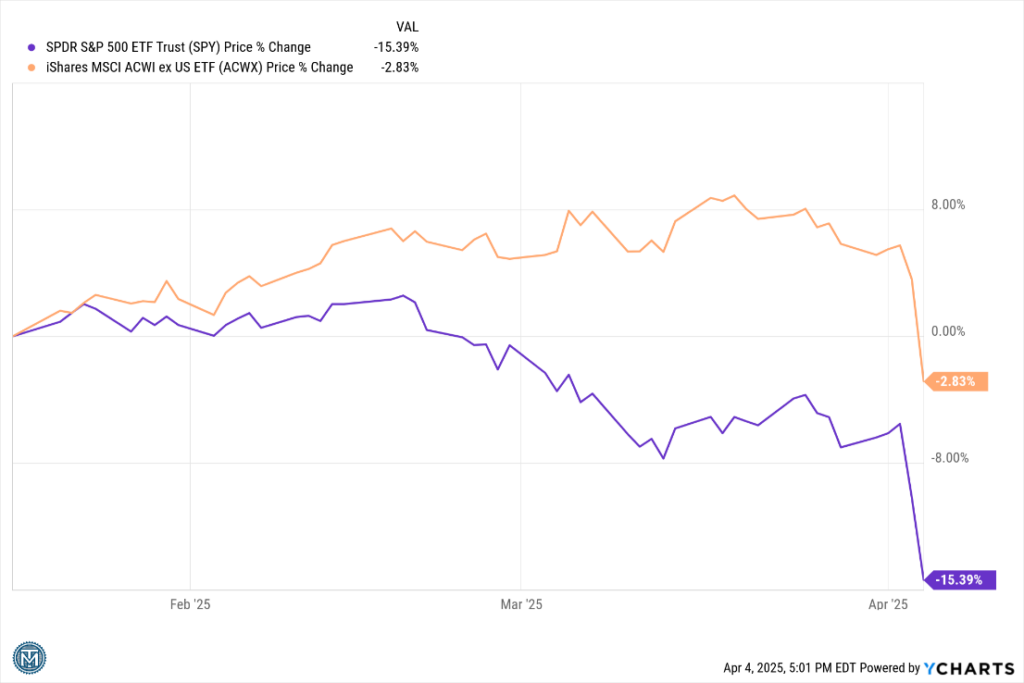
Truthfully, we don’t know whether this bold experiment will ultimately prove to be successful, or modestly successful, or mostly unsuccessful, or disastrous. It is too soon to tell. That said, markets are always trying to anticipate future results. It would have been possible to announce the tariffs on April 2nd with a meticulous explanation as to why each country was assessed the amount it was. When that didn’t happen, markets made a downward revision to anticipated future returns. Two days later, the administration revealed a mathematical formula (with Greek letters!) to justify how much each country was tariffed. Unfortunately for them, most economists can do math with Greek letters, and they were not impressed. Side note – one can write a formula using Greek letters to explain the basic premise of American football (you need to advance the ball at least ten yards every four plays), but that doesn’t make it especially complicated. So the reveal, which was basically that we tariffed each country roughly by the percentage of our trade deficit with them, blew a hole through America’s credibility and made markets go down even more. When the 90-day reprieve was announced on April 9th, markets rejoiced to the tune of nine percent in less than three hours, but that still left us considerably short of where we began, and we still have the tariff deadline looming ahead.
All of this makes portfolio management very challenging. Typically, when an investment analyst makes a forecast, he or she is trying to assess how fast the economy is going to grow, to what extent interest rates are going to rise or fall, and most importantly what the interplay will be between the economy and interest rates. Think about this as being like a dimmer switch in your dining room – based on new input one nudges one’s expectations up or down a bit. If necessary, you have to replace a less suitable asset with a more suitable one. Now think about how tariffs impact a forecast. A 5% tariff increase affects a company’s profit margins; maybe they pass it on to their customers, maybe they have to absorb it themselves, but they want to keep the business so they pay it. A 25% tariff, on the other hand, is probably too large to absorb. If they can’t pass most of it on, they have to consider foregoing the import and telling their customer to get it from somebody else. Recently, the Trump Administration and China have raised tariffs on each other to over 100%. That is a “FORGET IT” level. Nothing (except tiny components) gets bought or sold at that tariff level. Economies start to go south very fast when trade grinds to a halt. That’s not a dimmer – that is an off switch! A portfolio in a “dark” room is going to have to be a great deal different (more conservative) than a portfolio in a lighted room.
Obviously, the value of any income stream changes dramatically when its tariff rate changes from 40% to 10%, as happened on Wednesday April 9th. There was an intraday rally of almost 9%. It is very hard to model for something like that. How does an investor respond to this kind of volatility? If you are an investor not domiciled in the United States, you can’t possibly anticipate what the U.S. President might say or do next, so you protect yourself by selling dollar-based assets. You reduce exposure to the “suddenly-not-so-safe” haven of U.S. bonds and stocks and increase your weighting of alternative safe havens like gold (up 26.5% year-to-date) or the Japanese yen (+10.5%). This is what we have seen lately.
For the last decade or so prominent investors have used metaphors like “cleanest dirty shirt”[3] to illustrate the point that however concerned one might be about America that every other country as an investment option was considerably worse. American asset outperformance became so taken for granted in recent years that “American exceptionalism”[4] was widely used in investment circles. These notions are being called into question now. Again, I don’t know how this is all going to be resolved, but I do know that I can’t put the same valuations on U.S. assets that I did in the “TINA” (There Is No Alternative) Era. U.S. assets will necessarily carry lower premiums over foreign assets than they did from 2012 to 2024. It doesn’t mean they won’t produce nice gains, but as a whole they should underperform non-US bonds and stocks. Alternatives like gold and commodities are going to have to be a larger part of portfolios as well.
In all probability, the world has now entered a new era. The word “uncertainty” has been bandied about frequently in recent weeks. The Trump Administration has an ambitious agenda to shake up global trade and politics and make them more friendly to American interests, but that is exceedingly difficult under even the best circumstances. It will require a level of diplomacy that is so far not in evidence. I am not speaking from personal conviction here, I am simply conveying the message of the markets, and so far that message has not been very favorable. As the rally on April 9th demonstrates, there is room for asset prices to improve dramatically if tariffs are abandoned, but I have no thought that going through all of this for nothing would be regarded by markets as positive either. Because of the increased levels of both volatility and uncertainty, we at Trademark believe we have to exercise more caution, at least in the short term, than we have had to in recent years. We take our responsibility as manager of your assets extremely seriously. Over the past decade, stock market sell-offs have provided very good “buy-the-dip” opportunities. I am not as confident that this is the approach to take this time.
[1] S&P 500 large company index, according to Standard and Poors. The NASDAQ Composite fell -10.3% and the Russell 2000 small cap index sank -9.5% according to Nasdaq.com.
[2] This prompted James Carville, Clinton’s political strategist, to opine that if he were ever resurrected, he’d like to come back as the bond market because then he could intimidate everyone.
[4] A laudatory phrase from 19th century French political philosopher Alexis de Tocqueville.
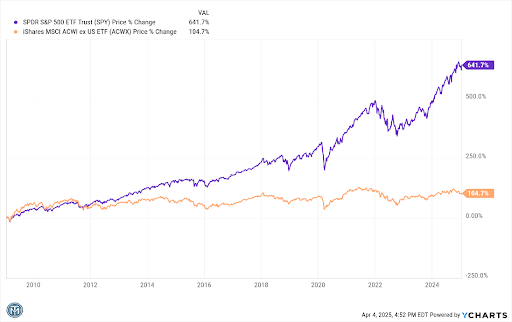
[i] A large part of the problem, as many in the market have stated, was that wasn’t clear why we needed to end the era of American market exceptionalism. If you look at a chart of relative performance, the U.S. was by far the largest beneficiary of the status quo over the last fifteen years or so. There is no economic policy that guarantees that absolutely everybody will do better. Clearly, many industrial jobs were lost during this time period (though far more were lost between 1985 and 2000). Congress sent money to the states many times to try to alleviate the economic pain of those who lost their jobs, but some states simply pocketed it or cut taxes (which, while nice, does nothing to help someone who isn’t earning any money).
In any event, we have begun a policy of blaming and punishing our trading partners for taking jobs we gave U.S. corporations tax incentives for moving under the Reagan, George H.W. Bush, and Clinton Administrations. Needless to say, those countries aren’t happy about it. So far, those industries most exposed to tariff concerns have fared worse than those that largely do business domestically, but even energy, which Trump promised specifically to help, has seen losses over 15% as global demand falls.
DISCLOSURE
Past performance is no assurance of future results. Trademark Financial Management, LLC (“Trademark”) is a registered investment adviser with its principal place of business in the State of Minnesota. Trademark and its representatives are in compliance with registration requirements imposed upon investment advisers by those states in which Trademark operates. Trademark may only transact business in those states in which it is registered or qualifies for an exemption or exclusion from registration. This newsletter is limited to the dissemination of general information pertaining to its investment advisory/management services. Any subsequent, direct communication by Trademark with a prospective client shall be conducted by a representative that is either registered or qualifies for an exemption or exclusion from registration in the state where the prospective client resides. A complete list of all recommendations will be provided if requested for the preceding period of not less than one year. It should not be assumed that recommendations made in the future will be profitable or will equal the performance of the securities in this list. Opinions expressed are those of Trademark Financial Management and are subject to change, not guaranteed and should not be considered recommendations to buy or sell any security. For information pertaining to the registration status of Trademark please contact Trademark at (952) 358-3395 or refer to the Investment Adviser Public Disclosure web site (www.adviserinfo.sec.gov). For additional information about Trademark, including fees and services, send for our disclosure statement as set forth on Form ADV from us using the contact information herein or by calling 952-358-3395. Please read the disclosure statement carefully before you invest or send money. Any reference to a chart, graph, formula, or software as a source of analysis used by Trademark Financial Management staff is one of many factors used to make investment decisions for your portfolio. No one graph, chart, formula, or software can in and of itself be used to determine which securities to buy or sell, when to buy or sell them, or assist any person in making decisions as to which securities to buy or sell or when to buy or sell them. Any chart, graph, formula, or software used is limited by the data entered and the created parameters. The data was obtained from third parties deemed by the adviser to be reliable. Nonetheless, the adviser has not verified the results and cannot be assured of their accuracy.
Trademark Financial Management – April 4, 2025
In negotiations, it can be valuable to create the impression that you are willing to take bigger risks than your adversary. Oftentimes, strategic “recklessness” can win concessions from an opposing party that is afraid to take the same risks. In order for this to work, the other side has to believe you are really crazy enough to do it, and your own side has to believe that you are only doing it for leverage and that you haven’t actually lost your mind. Call it “crazy like a fox” versus just plain crazy. Up until 3pm CDT on April 2nd, most of the market felt tariff negotiations were a bit of brinksmanship that would untimely lead to positive results. After the tariffs were announced, however, the perceptions changed. The tariffs were both larger than expected and seemingly without any regard to how the trade deficit with any given country came about or could be easily rectified. Thursday’s subsequent plunge in both stock prices AND the dollar were in sharp contrast to how the markets rallied back in November 2024 when tariffs were first threatened by the then President-elect. Then – crazy like a fox. Today – batcrap crazy.
Good negotiators need to know several things. One is the strength of their own position. Another is the ability for their opponent to back down. By openly challenging China to accept a very large tariff, he was seeking a very sought-after public “win”. Which China, playing the global public opinion game just as we are, could not afford to give him. They came right back and matched his 34% tariff. This morning, before the stock market opened, President Trump said he thought things were going very well. Effectively, he was saying he thought he would win in the end. The market thought “Oh no, this isn’t going to be over in a few days like we hoped.” A few hours later, investors’ desperate hopes for relief were dashed by Federal Reserve Chairman Powell, who said in essence, “I didn’t create this problem so it’s not mine to solve”.
Some explanation for why tariffs are such a frivolous issue is in order:
It is hard to see how the U.S. was hurt by running a trade deficit relative to our trading partners. They largely recycled the surplus into the purchase of U.S. bonds and stocks. Kind of a win-win. It wasn’t even a manufacturing jobs thing; those jobs were exported in the 1980s and 1990s. Blame Reagan, Bush I, and Clinton.
Journalist Andrew Eggar pointed out today that America doesn’t exactly want to wrestle the t-shirt market away from Honduras or Vietnam, because it would be difficult to get Americans to work at a t-shirt factory for a dollar an hour (which is what it would require for T-shirts to be sold for $5). Selling us cheap T-shirts does not harm America unless there were a large number of unemployed Americans who could afford to live on T-shirt wages. Unless we had a lot of semi-decent $200/month apartments available, nobody here could afford to take those jobs. Furthermore, America has largely become a services economy, not a manufactured goods economy. As such, we run a services surplus with almost everyone. President Trump did not factor this at all into his formula. The lack of credibility in terms of what countries were tariffed (Heard and McDonald Islands, only inhabited by penguins) contributed to the loss of confidence in the Administration and the results decline in both the dollar and stocks.
We are winning since Inauguration Day, but not in a good way.
In any event, the stock and bond markets are both pricing in reduced confidence that the tariff war will have a positive outcome, and they are both pricing in a much higher possibility of recession. Stocks that depend on economic growth (cyclicals) have been performing poorly, while stocks that are better positioned to ride out a recession (defensives) either gained or lost substantially less – that is, until today. At some point in a bear market, even the leaders get sold.
Safe treasury bonds have been gaining while riskier corporate bonds are slipping. We have been adding to our investment-grade bond positions because we think interest rates will decline as the economy continues to be harmed by the tariff war. High-quality bonds typically provide a bit of ballast against stock declines. We have been getting more defensive in stocks as well, but after the 9% plunge in stocks this week, it no longer makes sense to lighten up. 5100 on the S&P 500 (more or less today’s close) looks like fair value unless the tariff war drags on for months. If we can get a credible deal and no new attacks are forthcoming, we could bounce back up to 5500. I make no predictions.
DISCLOSURE
Past performance is no assurance of future results. Trademark Financial Management, LLC (“Trademark”) is a registered investment adviser with its principal place of business in the State of Minnesota. Trademark and its representatives are in compliance with registration requirements imposed upon investment advisers by those states in which Trademark operates. Trademark may only transact business in those states in which it is registered or qualifies for an exemption or exclusion from registration. This newsletter is limited to the dissemination of general information pertaining to its investment advisory/management services. Any subsequent, direct communication by Trademark with a prospective client shall be conducted by a representative that is either registered or qualifies for an exemption or exclusion from registration in the state where the prospective client resides. A complete list of all recommendations will be provided if requested for the preceding period of not less than one year. It should not be assumed that recommendations made in the future will be profitable or will equal the performance of the securities in this list. Opinions expressed are those of Trademark Financial Management and are subject to change, not guaranteed and should not be considered recommendations to buy or sell any security. For information pertaining to the registration status of Trademark please contact Trademark at (952) 358-3395 or refer to the Investment Adviser Public Disclosure web site (www.adviserinfo.sec.gov).
For additional information about Trademark, including fees and services, send for our disclosure statement as set forth on Form ADV from us using the contact information herein or by calling 952-358-3395. Please read the disclosure statement carefully before you invest or send money. Any reference to a chart, graph, formula, or software as a source of analysis used by Trademark Financial Management staff is one of many factors used to make investment decisions for your portfolio. No one graph, chart, formula, or software can in and of itself be used to determine which securities to buy or sell, when to buy or sell them, or assist any person in making decisions as to which securities to buy or sell or when to buy or sell them. Any chart, graph, formula, or software used is limited by the data entered and the created parameters. The data was obtained from third parties deemed by the adviser to be reliable. Nonetheless, the adviser has not verified the results and cannot be assured of their accuracy.
Market thoughts March 4, 2025 by Mark Carlton, CFA®
Dr. William J. Bernstein, Ph.D., M.D., a retired neurologist, and principal in the money management firm Efficient Frontier Advisors. He is also the author of several bestselling books on finance. In a 2021 MiB podcast, he made this observation:
“To the extent you succeed in finance, you succeed by suppressing the limbic system, your system 1, the very fast-moving emotional system. If you cannot suppress that, you are going to die poor.”1
Trademark Thoughts: Probably not, but you will almost certainly experience disappointing investment returns.
“Two years ago, the concentration of the U.S. stock market in its largest companies looked high compared to recent history. Today, some might say market concentration appears really high.”2
Trademark Thoughts: Huge outperformance from either growth or value hasn’t persisted historically. Gravity and mediocrity eventually catch up. Russell 1000 Growth is the worst performing of the three indices year to date.
From Bloomberg’s Money Stuff (Matt Levine):
“We talked last week about a paper by law professor Sue Guan, about how securities law does not really contemplate the modern reality of people buying stocks for non-financial reasons. I wrote: “If financial markets are increasingly a game, if what matters are not business fundamentals but memes and influence, then maybe nothing is securities fraud.”3
With memecoins — which are not even securities — this is even clearer. People want to buy memecoins because Dave Portnoy tweeted about buying them. He bought memecoins, tweeted about buying them, and sold them for a profit. There is nothing else going on here, so there is nothing for anyone to be deceived about; if there are no material facts, then nobody can be deceiving anyone about any material facts. “I don’t even know what I’m doing with my life,” was Portnoy’s takeaway from the experience, and mine too.”
Trademark Thoughts: A lot of what has gone on in financial markets over the last few years owes more to the area of psychology than to economics. If you buy something that has only “other people are buying it so the price is soaring” as an investment rationale, you have only yourself to blame if it fails.
Interesting and a bit scary…
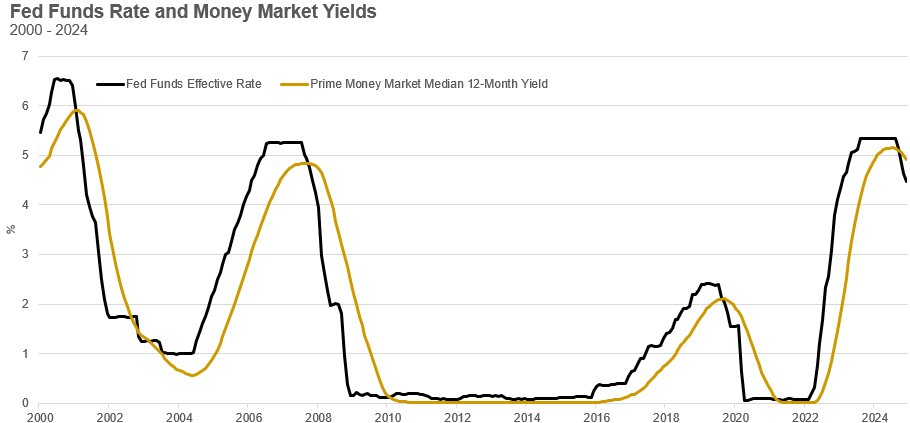
Historically, when the Fed funds rate has dipped below the money funds rate, stock prices have not done well. This is a warning sign.
On the current stock market sell-off: One can spot the conditions that suggest a higher level of risk, but one cannot predict when others will come to the same conclusion and act on it. Since the 2020 Covid-crash, stocks have done quite well as measured by the capitalization-weighted market indices, but the average stock has not done that well. These situations resolve themselves one of two ways – either small caps rally to catch up or large caps falter. Post-election there was a month-long surge in small cap stocks that rapidly reversed itself. Again, not a great sign. That said, however, betting against the largest 7 stocks has really hurt returns in recent years so one isn’t going to sell because the market might go down. One waits for confirmation. Confirmation isn’t a 5-8% plunge in stock prices – those happen frequently. Confirmation is a meaningful drop, a weak recovery, and a plunge to a level lower than the previous low. We aren’t there yet. More often than not, the plunge creates value and the market regains its “footing” and eventually a new high is recorded. Until the market decline is confirmed, we are looking for a rebound. But given the extremely unsettled macro environment – tariffs, layoffs, etc., we are going to have a short leash.
Past performance is no assurance of future results. Trademark Financial Management, LLC (“Trademark”) is a registered investment adviser with its principal place of business in the State of Minnesota. Trademark and its representatives are in compliance with registration requirements imposed upon investment advisers by those states in which Trademark operates. Trademark may only transact business in those states in which it is registered or qualifies for an exemption or exclusion from registration. This newsletter is limited to the dissemination of general information pertaining to its investment advisory/management services. Any subsequent, direct communication by Trademark with a prospective client shall be conducted by a representative that is either registered or qualifies for an exemption or exclusion from registration in the state where the prospective client resides. A complete list of all recommendations will be provided if requested for the preceding period of not less than one year. It should not be assumed that recommendations made in the future will be profitable or will equal the performance of the securities in this list. Opinions expressed are those of Trademark Financial Management and are subject to change, not guaranteed and should not be considered recommendations to buy or sell any security. For information pertaining to the registration status of Trademark please contact Trademark at (952) 358-3395 or refer to the Investment Adviser Public Disclosure web site (www.adviserinfo.sec.gov).
For additional information about Trademark, including fees and services, send for our disclosure statement as set forth on Form ADV from us using the contact information herein or by calling 952-358-3395. Please read the disclosure statement carefully before you invest or send money. Any reference to a chart, graph, formula, or software as a source of analysis used by Trademark Financial Management staff is one of many factors used to make investment decisions for your portfolio. No one graph, chart, formula, or software can in and of itself be used to determine which securities to buy or sell, when to buy or sell them, or assist any person in making decisions as to which securities to buy or sell or when to buy or sell them. Any chart, graph, formula, or software used is limited by the data entered and the created parameters. The data was obtained from third parties deemed by the adviser to be reliable. Nonetheless, the adviser has not verified the results and cannot be assured of their accuracy.
Trademark Blog Post – December 11, 2024:
The U.S. stock market surged after the November election. Investors remembered that in the first year of Donald Trump’s first term (2017), in which taxes were cut, regulations were curtailed, and government spending took off. This combination made for a very good year for stocks, so the market is betting on the same combination in 2025. It may happen, but it’s important to note that the economy was growing at a much slower rate in late 2016 and inflation wasn’t on anybody’s mind back then. A tax cut not offset by fiscal restraint (spending cuts) would probably unnerve the bond market, leading to higher interest rates. The selection of Scott Bessent for Treasury Secretary initially helped calm the bond market due to his long career on Wall Street.
Much of the fuel for the gain in the U.S. stock market has come from investors shifting out of foreign stocks and currencies. It appears investors (both here and abroad) feel that at least initially the proposed tariffs will take a larger bite out of foreign stocks and currencies. The big question for 2025 and beyond is – how big will the response be?
Another thing that seems to be driving markets recently is the explosion in digital assets. While the U.S. stock market is 6.6% ahead of its close the day before election, bitcoin is 50% higher. Some tokens have done even better. The proximate cause for this is that the incoming Trump Administration promises to be much more friendly to “cryptos” than the Biden Administration’s regulators were. Gains of 50% or more in a very short time period in several of the digital tokens drove investors into a bit of a speculative frenzy, because they believe they can really get rich quick. This bled over into stocks; the artificial intelligence and quantum computing sub-sectors have soared almost as much as digital assets. Markets that trade on hope and greed are exciting, but they tend not to end well. If money management were nothing more than performance chasing, we would know where to invest, but we could not guarantee we’d have a chair, so to speak, when the “music” stopped playing. This is an exciting but dangerous time to be an investor.
Fraudsters don’t take holidays:
With the holiday season upon us fraudsters are ready to take full advantage of any opportunity to gain access to personal information. Both Trademark Financial Management and Charles Schwab are committed to protecting your private information. Schwab released a list of common fraud methods to help you, and your friends, family, and colleagues shop safely this holiday season.1
First, be sure you’re familiar with the most common fraud methods:
Phishing /Email Account Compromise: Scammers send deceptive emails, texts, or messages designed to trick recipients into clicking malicious links or revealing sensitive information, often by impersonating reputable organizations. Additionally, thieves may attempt to gain access to e-mail accounts and use them to intercept financial communications or initiate fraudulent requests. Remember to always verbally verify all money movement instructions received via e-mail–including 1st party money movement requests.
Social engineering: fraudsters may pose as trusted retailers, charities, or even friends, pressuring victims into providing sensitive information or making payments. Stay skeptical of unsolicited requests and verify independently before acting.
Financial account takeover:Fraudsters use stolen credentials, malware, or breached information, to gain unauthorized access to accounts, often using the holiday season’s surge in online shopping to make unauthorized credit card purchases or transfers. Monitor accounts closely and report suspicious activity immediately.
Questions to ask when shopping online:
Are you on a secure network? It’s easy to hit the “Buy” button from anywhere when you are on your phone or laptop. But if you’re shopping on a public network, your personal information—and your credit card number—might be intercepted by scammers. Wait to purchase until you’re on a secure network.
Is this retailer or website genuine? Fraudsters set up convincing fake online stores offering discounts that are too good to be true. Always verify the legitimacy of websites before entering personal or payment information.
Is this shipping update legit? Be wary of unexpected emails or texts claiming to be from shipping companies asking you to click on links to confirm delivery details. These links often lead to malware or phishing attempts.
How do I know this gift card is valid? Gift cards are convenient, but they can open the door to scams. To ensure your gift card is protected, avoid the rack, and ask for one directly from the person behind the counter. And remember—no legitimate retailer or charity will demand gift cards for payment.
Can I trust this deal I saw on social media? Too-good-to-be-true deals on social media sites are often illegitimate. Carefully read reviews, look for security credentials on websites, and research unfamiliar retailers before you take advantage of a discount. A secure site will display https:// in the URL and a padlock icon in the address bar.
Can I pay by credit card? These cards offer the best protection against fraudulent transactions.
What does the Better Business Bureau have to say? Their scam BBB Scam Tracker can help you identify crimes and issues that are occurring in your area.
Both successful and prevented fraud attempts should be reported immediately.
On a personal note:
On Wednesday morning my mother, Donna Carlton, died at the age of 83. She had a 33-year career in financial services, starting out in 1977 when there were very few women in the industry and almost none in any kind of leadership role. She was successful because she worked very hard and she really cared about her clients. She gave me my start in the industry as an office assistant and early computer software user, and in doing so I found an aptitude for the analytical side of the business. Her father, my grandfather, had owned a dry goods store on the Iron Range in its heyday. He always told her that if you took care of your customers, they would take care of you. That is how she ran her business until she retired in 2010, and what I learned from her. I will always be in her debt.
Past performance is no assurance of future results. Trademark Financial Management, LLC (“Trademark”) is a registered investment adviser with its principal place of business in the State of Minnesota. Trademark and its representatives are in compliance with registration requirements imposed upon investment advisers by those states in which Trademark operates. Trademark may only transact business in those states in which it is registered or qualifies for an exemption or exclusion from registration. This newsletter is limited to the dissemination of general information pertaining to its investment advisory/management services. Any subsequent, direct communication by Trademark with a prospective client shall be conducted by a representative that is either registered or qualifies for an exemption or exclusion from registration in the state where the prospective client resides. A complete list of all recommendations will be provided if requested for the preceding period of not less than one year. It should not be assumed that recommendations made in the future will be profitable or will equal the performance of the securities in this list. Opinions expressed are those of Trademark Financial Management and are subject to change, not guaranteed and should not be considered recommendations to buy or sell any security. For information pertaining to the registration status of Trademark please contact Trademark at (952) 358-3395 or refer to the Investment Adviser Public Disclosure web site (www.adviserinfo.sec.gov).
For additional information about Trademark, including fees and services, send for our disclosure statement as set forth on Form ADV from us using the contact information herein or by calling 952-358-3395. Please read the disclosure statement carefully before you invest or send money. Any reference to a chart, graph, formula, or software as a source of analysis used by Trademark Financial Management staff is one of many factors used to make investment decisions for your portfolio. No one graph, chart, formula, or software can in and of itself be used to determine which securities to buy or sell, when to buy or sell them, or assist any person in making decisions as to which securities to buy or sell or when to buy or sell them. Any chart, graph, formula, or software used is limited by the data entered and the created parameters. The data was obtained from third parties deemed by the adviser to be reliable. Nonetheless, the adviser has not verified the results and cannot be assured of their accuracy.